Showing posts with label poetry. Show all posts

Thursday, September 15, 2016

Conversation 3

What are we learning this week?

Monday: Observation / Point of View
Tuesday: Slice of Life in Conversation
Wednesday: Conversation of Objects
Thursday: Conversation: Poem in Two Voices

You may have read the poetry book, "Joyful Noise: A Poem for Two Voices," by Paul Fleischman.


Listen to Mrs Mathieson's students read their Poems for Two Voices:


 Poetry, they explain, is a global language of expression, emotion, opinion, and, in two voices, perspectives. You'll hear sports, love & hate, Mother & Daughter, and many more.  Listen to how they spoke separate at times and at other times together, to show compare, contrast, and the strength of each voice and perspective.

It seems like a conversation; it could be. It could be a separate idea thinking to itself, but read together.

So think of two things: people, objects, cause/effect, problem/solution, issues. Compare and contrast the two things you choose. What would they say, to each other or by themselves? Be active and precise in your word choice, as you write what each would say. Then juxtapose your two poems into one poem for two voices.

For example. Yesterday the sun and the coneflower exchanged words in a conversation.

How might I compare and compose two voices based on those two ideas:

~~~~~~~~~~~~~~~~~~~~~

Coneflower and The Sun

Ah.
Oh
I love the streaming
I love

flinging out my energy
rays warming my petals

Yellow and bright


bright and piercing
Like I am the sun

shining forever
shining forever

reaching out onward

as the circle of planets
but I grow cold


In the cold
in my place
of my space
as earth’s tilt and turns
lose the warmth
lose the warmth
of Sun’s rays.
of my rays.

I shine on
My shine dims

My petals fall

My leaves brown


I shine on
My seeds fall

I live on
I live on
In spring sprouts


And on
A cycle of life.
A cycle of life.


~~~~~~~~~~~~~~~~~~~~~

Your turn!  What objects carried on a conversation for you yesterday? Use those or another two objects to create your own poem for two voices.

Share the link in the comments below.
~~~~~~~~~~~~~~~~~~~~~

Note: I created the poem in Google Docs in a table for each line. 
I changed the table properties by setting the table border at zero (0). 
I then copied/paste the title and table into my blog. 

Photo: Sheri Edwards 


A resource on Poems for Two Voices: 

Monday, September 12, 2016

Mondays: Shift: Seeing Things in a New Perspective


My mom had an old book of puzzles. I loved it. My favorite puzzles were simple sketches that suggested something. What do you think the above image is?

Is it a bear climbing a tree? A giraffe walking by your window? A snake slithering across your beach towel?

With each question, your eyes shift to see the pattern in a new way. This is important for writers.

My mom could see beyond the obvious, and helped me look at the bigger picture. As a young mother rushed in front of us in the grocery line, mom would say, “She needs to get her back home for baby’s nap.” That might not have been true, but mom always took a step back to see a bigger idea and a step into the shoes of others.

We need to step around to see. Turn things around, and get a different view. Try to think from another’s perspective. Believe in your own!

So on Mondays, try something different. Sit in a different place on the bus or in your classroom or at lunch. Start a conversation with someone new. Really listen to what they say and understand their point of view.

Consider the main character of your favorite movie or book. Put them into another movie or book. Write a scene of the two main characters talking. What would they discuss? plan? do?

Be the characters, not yourself. Adopt their persona, with all their problems and personality traits. Really. What would the really discuss?

Here's a poem where the author took on the persona of Spiderman, except they added a new detail: Spiderman has a speech problem.


How did the author explain Spiderman?
How did the speech change how you feel about Spiderman?
What's the same, but what's different?
Do you hear his voice? his personality? a little tinge of sadness?

Choose your own superhero. Think about what he says and does. Write your poem. Did you add something that others might not know about his personality? What persona did you take?

These ideas shift your mind into another person or character, and then ask you to insert another difference to change the persona even more. Get into the character's personality so you can write as if you are that persona, like an actor would, with that voice.

Another way to shift perspectives is to take the view of another part of the scene. Say you're eating Cheerios.  What if you were the Cheerios in the box, poured out, milk added, and then that spoon? Be the Cheerios.

Or be your shoe!

Here's a reading by Amy Ludwig Vanderwater called "Waiting Room Fish"

You can imagine the fish looking back at you while you wait in the doctor's office: "We peek between the plastic plants." You hear the timid and patient voice of fish tank fish.

Go ahead -- be something different, a shift in perspective and write a story or poem. Let their voice shine through.


Friday, September 9, 2016

Poetry Friday: Each drawer is different

Poetry: What is it?

An interesting piece about poetry from Ron Padgett provides a beginning for us.


It's fourteen lines that look the same, but you can't say it the same 14 times. Try it.

As the poet explains, there are many, many kinds of poems: tiny, long, nature, funny, serious, patterns, etc. But the thing is, once a poem is written, it is never read the same. Each of us puts our own emphasis on the parts and the meaning. They are gifts given from within one person, presented outside of himself, so you the reader can take it within you.

When I first saw this poem, I imagined someone looking for something, but not finding it any place he looked. Now that I heard the author, and heard his inside feelings of the poem, I see it as an experiment in feeling the words and how each time they are said, the words become something else, depending on its reading.

It's rather like mood too. You could read that poem when you're tired, and it would sound different.

You could read it when you're angry, and imagine how it would sound!

You could read it when you're bored, and how long would it take to read it?

So poetry is feeling, it's sound, it's emotion, and it's imagery -- and a gift each of us will read differently.

Five things to do [not on one day-- but do try them all].

1) Think of a phrase, something plain or something special, something boring or something joyful, or some other emotion. Write it fourteen times. Read it to someone. Ask them to read it to you. How were your readings the same or different? What does that show you about poetry?

Leaves of fall, fall.
Sheri Edwards 
Leaves of fall, fall in colors.
Leaves of fall, fall in colors.

2) Go to poets.org and choose "Forms." Choose a few to read. Which did you choose? What surprised you about each? Which would you read again? Which could you write?


3) Go to poets.org and choose "Themes." Choose a theme and choose few poems to read. Which did you choose? What surprised you about each? Which inspired you to write a poem on that theme?

4) Choose a form or a theme of a poem. Write your own. Share it below so we can read your gift. You may want to create and share an audio recording of your poem, so we know how you would read it. We may read it our way, but we'll always thank you for your gift.

5) What surprised you about reading poetry? What surprised you about writing poetry? How would you explain poetry to someone else, now that we've heard from Ron Padgett and other poets you've read?


Please write a short note and a link to your responses in the comments below.

~~~~~~~~~~~~~~~~~~~~~~~~~~~~~
Poetry Friday Host: The Poem Farm


Sunday, June 24, 2012

Poetry Friday on Tuesday


Tuesday Quick Write
Kate Messner's Teachers Write Camp

6/19

Guest author Sara Lewis Holmes  suggests this about poetry:

Part of her introduction to poetry:
"We write poetry in response to the things that set off alarms inside us. The moments when we are vibrating with wonder, or fear, or heartbreak.  Poetry is most definitely FEELING.
But we also write poetry to examine things more closely; to cry out: that’s not the same thing!  To logically parse a silly thought until it reveals something we didn’t understand when first we were alarmed. Poetry is most definitely THOUGHT. Perhaps that’s why I love Auden’s definition of poetry as 'clear thinking about mixed feelings.'"


Her assignment to us:
"1) Tell me about a time you didn’t reject the first silly thought or phrase that came to you—and what happened afterwards. Write a poem about it if you wish.
2) When you have a free evening, find the recent documentary, Louder Than a Bomb, which follows four teams of students as they prepare for and compete in a Chicago poetry slam. Need a quick jolt immediately? Here’s seventeen-year-old Adam Gottlieb performing “Poet, Breathe Now.”
3) Begin a “commonplace book.” This is simply a notebook into which you copy poems you want to keep nearby. You can do this by hand, inking in the lines, or do what I often do: print or make a copy with your computer, and paste it in. Or do both—no rules! Try reading from this commonplace book before you approach your regular writing time, and see if it puts you in the right frame of mind to be both open and clear.
4) To explore your mixed feelings, write a credo. But do it slant, as Emily Dickinson would advise. Start with “I don’t believe in…” and see where your intrepid words take you."


+++++++++++


First: I've chosen prompt 4: I don't believe:


Next: Here is Sara's Credo Poem -- A model for us

And now, mine:


I don't believe in giving up.
I don't have time to write this poem,
It's not even Tuesday; it's Sunday,
but I can't let go of my commitment.

I don't believe in giving up.
I had three days of class this week.
Out of town, away from my safe harbor.
And I want to finish my poem.

I don't believe in giving up.
Although I do believe in adapting
and revising and reforming so it's doable
For me. I will be able to finish my poem.

I don't believe in giving up.
And I don't let my students give up either.
We adapt and revise and reform so the work is doable
For them. They will be able to finish their work.

I don't believe in giving up.
We look together at what needs to be shown
And decide on how each will find a way and a when to show
to me for them what must be done. They do commit to their work.

I don't believe in giving up.
Commit, Adapt, Revise, Reform, Extend.
I don't believe in giving up
But sometimes, I let go.

I don't believe in regrets.
I live each day as best I can
And do as best I can
Fulfilling, for sure, promises.

I don't believe in regrets.
I know that twenty-four hours and sixty-two years
Are both short and long;
Get done with what I can.

I don't believe in regrets.
We look forward to keep going.
We can't see behind without
A mirror, but that's no longer real.

I don't believe in regrets.
So when I can't, when it's too much,
I let go.
I let go and let it behind.

I don't believe in regrets.
Sometimes a student resists everything
We could do for success. What do you do?
Let go.

I don't believe in regrets.
I don't believe in giving up.
I do what I can and then
I am done with it.

Let go.


+++++++++++


Your Turn:

Which prompt will you try?

I hope your try your thoughts wrapped up into an "I don't believe in" poem and share it here.

Tuesday, April 21, 2009

Poetry Self-Portraits

Purpose

Create an artistic impression of youself through art, essay and poetry. Follow these directions for your draft. Then create a "W8 2009 Code" Page to type up your list and begin your drafts and revisions.


Idea Lists

Create lists of at least ten items to finish each of the following:

I like:

I am:

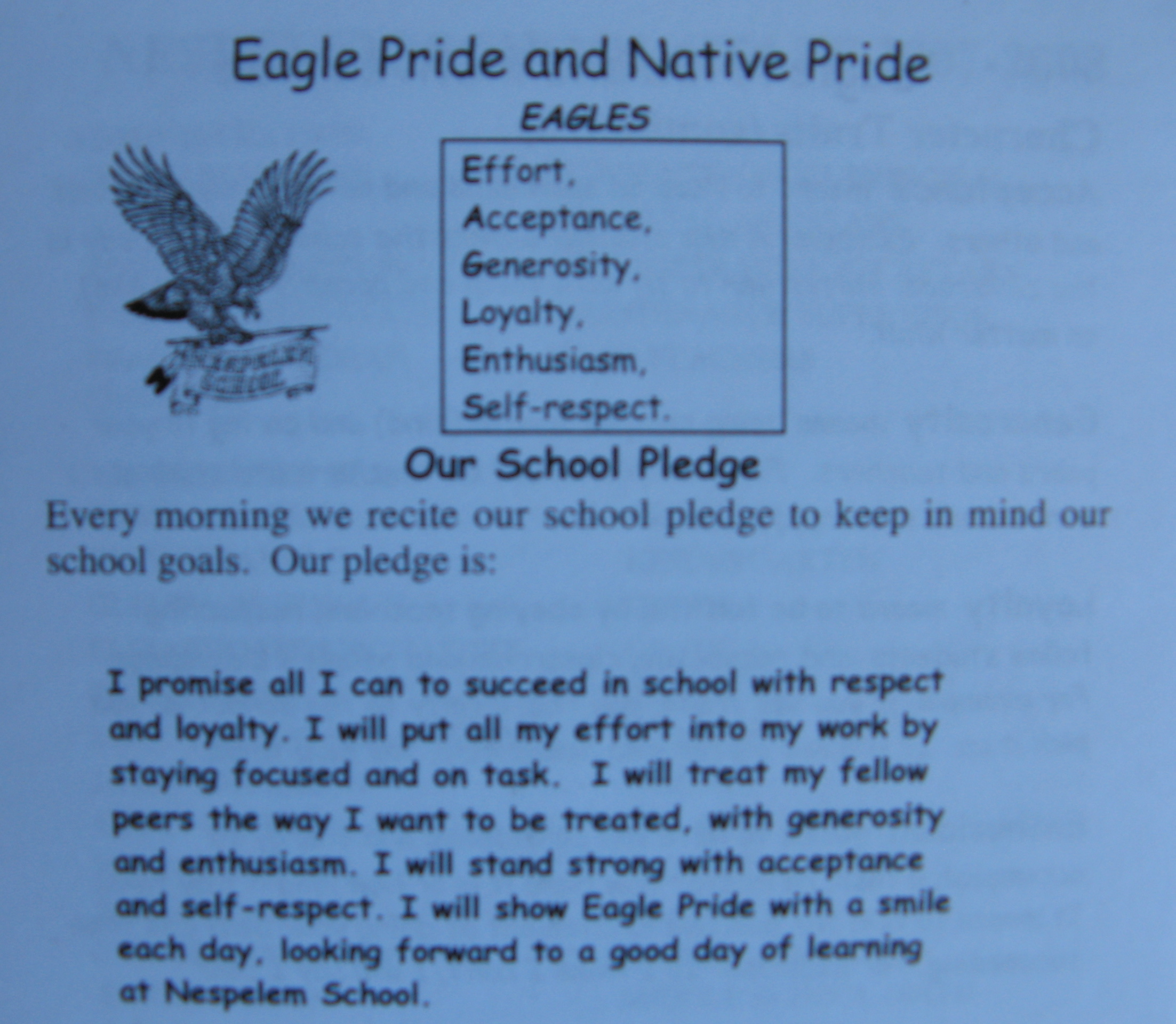
Of the eagle traits, I am __________ because__________ (See bottom of page; choose at least two)

Animals I am like are (at least three):

________ because ______

________ because ______

________ because ______

Ten years into the future, I will:

Image (Square)/Symbol

Read over all your lists. Try to think of images that represent you, your traits, your likes, the animals you associate with, etc. Use those images to create a square symbol that represents you as a whole person. Use large pictures and color.

Example:

Poem

Write a descriptive poem that expresses each of your traits represented in you symbols. Explain each image with examples and each major color as a symbol of one of your traits.

Hints:

Start out with the question: Who am I?

Then describe yourself using your images as examples.

The beginning to the example symbol might be:

Who am I?

I am a cat wrapped in a circle sitting in the sun napping for the afternoon. I show the pleasant and friendly things in life.

I am spicy pepperoni, sizzling in your mouth bursting with flavor like an enthusiastic cheerleader cheering for our team.

I am the blue sky providing sunlight and power, just as I provide kindness and help to my family. I help them like a wolf pack protects and provides for each other.

I am clicking keys, tapping my creative thoughts on the screen as I transform ideas into prose or poetry about the laughter of several grandkids chattering over their imaginary and evolving games in the shade of the sycamore in the backyard.

I am floating in the shade on the boat on a hot afternoon reading or ambling with Pooka on the grassy path near the calm lake listening to the sounds of seasonal birds just before gently swinging on the bench swing with grandkids by my side, relaxing after a fun day of togetherness.

Essay

Write an engaging explanation of your symbol using as many of the list ideas as you can. Each list could be a paragraph, ending with your future goals.


Wordle

Copy and paste your lists from your "W8 2009 Code" page into the site at:

http://www.wordle.net/create

to create a Wordle about you. Take a screen shot of it (ask how). We'll add it to your site with proper citation. If you write your name five times in the list, your name will show up largest.


Sample Lists and Wordle:

I like:

  • floating in the shade on the boat on a hot afternoon reading
  • ambling with Pooka on the grassy path near the calm lake listening to the sounds of seasonal birds
  • listening to the laughter of several grandkids chattering over their imaginary and evolving games in the shade of the sycamore in the backyard
  • hearing the click of keys tapping my creative thoughts on the screen as I transform ideas into prose or poetry
  • gently swinging on the bench swing with grandkids by my side, relaxing after a fun day of togetherness
  • transforming images of friends and family into a visual story through digital iMovies
  • observing the "aha!" of students whose minds marvelously pop with a sudden understanding of a concept
  • listening to the soft purr of my cat trusting his world to me
  • melting flavor of dark chocolate slowly dissolving into a silky sliver in my mouth
  • engaging dialogue on substantial topics with always sensitive and insightful Scott

I am

  • diligent
  • creative
  • focused
  • serious
  • productive
  • pleasant
  • geeky
  • inventive
  • stubborn
  • thoughtful

EAGLE Traits

I show the EAGLE trait of effort when I write carefully and personally tuned lessons for my students.

I display acceptance when I acknowledge the differing needs and personalities of students.

I live enthusiasm when I stand in front of dull eyes and turn them into sparkles with words and ideas.

I exhibit generosity in spirit when I offer alternative assignments for students.

I demonstrate loyalty by teaching at Nespelem School for twenty-four years.

I model self-respect when I get my work done.

Animals I am like include

  • cougars for their independent striving for survival
  • wolf to help my family like a pack protects and provides for each other
  • cat who likes nothing better than a nap in the sunshine


In the future ten years from now, I will
  • be volunteering to help in schools with computer projects
  • be helping grandkids with projects
  • hiking with Scott behind city hall
  • sharing conversations with family and friends
  • be writing a book about thinking

Wordle

http://www.wordle.net/create


EAGLE Traits

Friday, March 27, 2009

A Poem in Your Pocket

Help spread the power of poetry -- share ideas on twitter for how to share poems on 4/30 for "A Poem in Your Pocket Day" on April 30th. Label tweets #ppocket

Here's the first idea:

Create your own visual poem on Bubblr; blog or email it to friend for "A Poem in Your Pocket Day" on April 30th:

The Poem:

Spring
Barren earth
Blossoms in bubbles
Of delicate dew
For butterfly blessings
Mother Earth to you.

The visual:

Or link here: A Poem for Your Pocket by Sheri Edwards

HOW TO:

Go to Bubblr at http://www.pimpampum.net/bubblr/

Use the "tag" box to type a topic on which you want to write a poem.

I chose these (separately as needed): soil, spring, dewdrop

For your search, many photos will appear for you to drag to the current slide.

As I chose my photos, I added the cloud and text.

Then I published with a title and name from which the code can be created to embed or link or email. Enjoy.

National Poetry Month
Poem in Your Pocket

Go boldly and scatter seeds of kindness...
Reflect curiosity and wonder...

Thursday, February 19, 2009

Poetry and Pictures with PicLit

Love poetry? Here's your chance for focusing ideas and imprinting images by adding text to pictures.

Here's an example:

PicLit from PicLits.com
See the full PicLit at PicLits.com

The text says:

Lincoln
Remembered
dreams
for
us.

Will
we?

I chose the picture to honor President Abraham Lincoln's 200th birthday this year. I chose the words from a list provided for me. I chose those words because Lincoln knew we needed to stay together as a Union -- united together. He remembered the dreams we all have, and worked to keep the dream of America and us alive. Will we?


How to create your own poetry pictures?


1. Go to PicLit
2. Choose a picture.
3. Connect to it with your ideas and experience.
4. Read the words in the list provided. Develop in your mind a message that expresses your ideas.
5. Choose the words that express your connection to the image. Be short and concise -- the picture should dominate, and the words should draw out a theme from the image.
6. Save, email, blog, etc.
7. You can also take a screenshot, but be sure you credit PicLit.

Poetry in Pictures, a fun way to learn to be concise and exact.